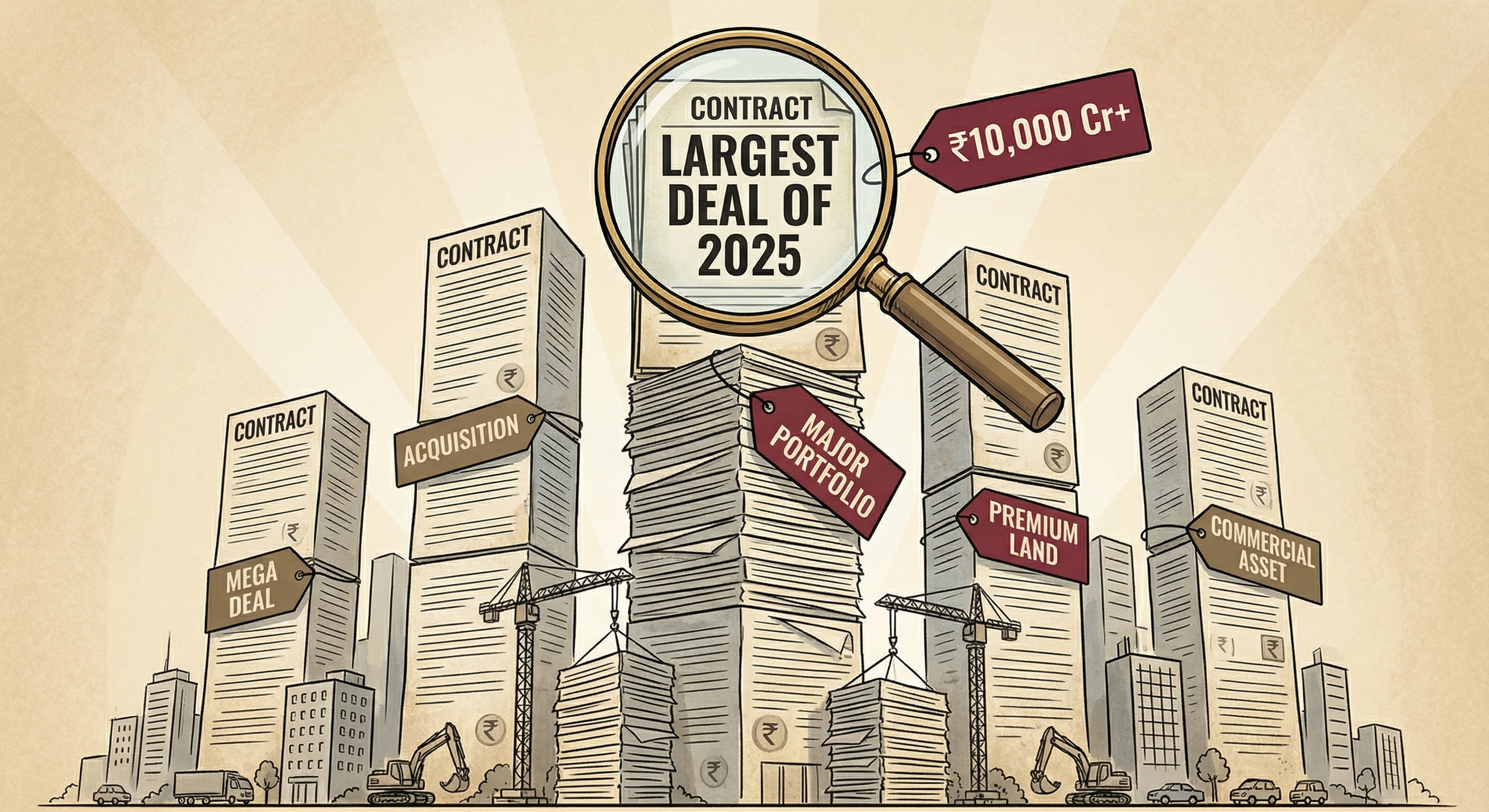
India’s real estate sector is undergoing one of its most transformative phases, and the first half of 2025 stands as clear evidence. Developers across the country executed ₹30,885 crore worth of land acquisition deals, covering 76 transactions and 2,898 acres, marking one of the most aggressive expansion cycles in recent years. This surge reflects a renewed developer confidence driven by strong end-user housing demand, commercial absorption highs, and the rising need for large-format township and mixed-use projects.
For Propzine, Bengaluru’s homegrown proptech platform, this trend offers deep insights into how India’s geographic growth patterns are shifting and why land has become the most strategic asset in the real estate value chain.
A Nationwide Buying Spree: Developers Accelerate Land Purchases at an Unprecedented Pace
The scale of land acquisition in H1 2025 highlights a major inflection point for Indian real estate. Developers are aggressively locking in supply pipelines, preparing for sustained demand over the next decade. From luxury housing developers to institutional-backed platforms, the appetite spans across residential, commercial, plotted, and integrated township formats.
The larger message is clear: developers are no longer purchasing land opportunistically; they are building long-term land banks that can support multi-year launches and broader diversification strategies.
Tier 1 Cities Dominate: MMR, Pune & Bengaluru Lead India’s Land Deal Activity
While land deals have spread nationwide, three major real estate hubs dominated the acquisition charts in the first half of 2025.
• MMR (Mumbai Metropolitan Region): 433 acres
As India’s most land-constrained metro, even incremental acquisitions carry massive development
value. MMR’s demand compression and premium pricing make it the most lucrative region for developers
seeking high ROI.
• Pune: 214 acres
Pune’s growing IT workforce, infrastructure expansion, and mid-income housing boom are attracting
large developers targeting scale-driven projects.
• Bengaluru: 182 acres
India’s Silicon Valley continues to be a magnet for real estate investment. With rapid absorption in
East, South, and North Bengaluru, developers are securing land for townships, high-rise communities,
and premium tech-corridor projects.
For Bengaluru specifically, this surge aligns with rising demand for larger integrated communities, strong white-collar employment, and enhanced connectivity via the Namma Metro expansion.
Massive Development Pipeline: 233 Million Sq Ft Potential Unlocked
The 2,898 acres transacted in H1 2025 carry a total development potential of 233 million sq ft, making it one of the largest future supply pipelines in India’s modern real estate cycle. This potential spans across:
• Residential high-rises
• Plotted developments
• Integrated townships
• Commercial and mixed-use parks
• Retail-led developments in emerging corridors
The pipeline confirms a long-term confidence in India’s demographic-driven demand, particularly among urban and semi-urban households transitioning into mid and premium housing categories.
Revenue Potential Hits ₹1.47 Lakh Crore: The Biggest Growth Trigger for Developers
The projected ₹1.47 lakh crore revenue potential from these H1 2025 land deals underscores the financial magnitude of this acquisition wave. Developers are no longer just buying land they are locking in multi-year revenue visibility, supporting stronger balance sheets and reducing dependence on volatile market cycles.
This revenue potential will be unlocked mainly through:
• High-velocity mid-income housing
• Premium and luxury launches in metros
• Commercial office parks in Tier 1 IT hubs
• Retail developments in high-footfall micro-markets
• Mixed-use urban clusters in fast-growing districts
The overall impact is expected to significantly uplift the financial performance of India’s top developers over the next 3–5 years.
Tier II & Tier III Cities Rise: 28% Share Signals India’s Next Growth Frontier
One of the most important shifts visible in H1 2025 is the growing share of Tier II and Tier III cities, which accounted for 28% of total land transaction value. Cities like Jaipur, Lucknow, Coimbatore, Indore, Nagpur, and Bhubaneswar are emerging as real estate growth engines driven by:
• Rising local incomes
• Infrastructure upgrades
• Improved connectivity
• Migration from smaller towns
• Demand for organized housing
These markets offer larger land parcels at attractive valuations, creating opportunities for township-scale developments that are challenging in dense metro cores.
For developers, these cities represent the next decade of high-volume growth mirroring the early evolution of today’s big metros.
Conclusion: India’s Land Acquisition Boom Is Reshaping the Future of Real Estate
The ₹30,885 crore land acquisition spree in H1 2025 marks a structural turning point for Indian real estate. With 76 deals, nearly 2,900 acres, and over 233 million sq ft of development potential, developers have positioned themselves for a long runway of expansion.
Tier 1 cities like MMR, Pune, and Bengaluru continue to dominate, but the rapid rise of Tier II/III markets signals a wider, more inclusive growth cycle. For investors, homebuyers, and proptech innovators, this land boom sets the foundation for India’s next transformative phase in urban development.